A breast cancer diagnosis changes more than a person’s health. It can reshape priorities, strengthen relationships, and offer a new perspective on what matters most. For one Placer Breast Cancer Foundation volunteer, the journey through treatment became a reminder to slow down, care for herself, and reconnect with the community she loves. In this Q&A, she shares her personal story, the lessons she learned along the way, and why she believes early detection can save lives.
How are you affiliated with PBCF?
I’m a volunteer of PBCF and most recently supported Dinner in the Orchard. My participation started with the owners of Happy Dayz Vineyards, Rick and Jacque Kennedy, who host the Annual Dinner in the Orchards event in June. Throughout the years, I’ve been familiar with the foundation through the stewardship of many of its leaders, including Carol Garcia and the late Aldo Pineschi.
How did you first learn you had breast cancer?
I was diagnosed with breast cancer in late June 2025. I’d always known my risk was higher due to family history, but found some relief that my mom did not carry the BRCA gene. I was calm during the discovery of my lump, the diagnostics, and biopsy. However, it must have been my body preparing me for the roller coaster coming. I received the call while at work and quickly drove home, finished a virtual call, and then turned around to tell my husband the somber news. We’ve both lost parents to cancer and witnessed the devastation firsthand.
My journey began from a young age as my mom prepared myself, and my older sister, for the seriousness of cancer. She did this because my maternal grandmother died at 34 after being slowly butchered during her battle with breast cancer in the 1950s. My mom was 11 years old when her mother died, which was the same age as my daughter at the time of my diagnosis in my thirties. Unfortunately, my mother’s greatest fear of dying too soon and leaving behind her children came true. She battled ovarian cancer for over two years and passed away when I was 16 years old.
What did having breast cancer help you learn?
Breast cancer grounded me and reminded me to reprioritize the things that matter most. My family, friends, and community, but most importantly to prioritize myself. Someone recently reminded me how aviation safety instructs you to put on your own mask before helping others. I wasn’t doing that as I worked long hours for years. I was often telling my children to wait while I solved a problem or addressed a call, arriving home after everyone finished dinner, and working weekends.
My diagnosis led me to pause and focus on my own health and wellbeing. One of my treatments involved a month of daily weekday visits to Mercy San Juan Cancer Center. I had the earliest appointment of the day, but a small gap of time between dropping off my children at school, commuting to Carmichael, and eventually checking in for my appointment. After the first day, I decided to use this morsel of time for positive movement. I started walking the campus on those fall mornings to help my daily step goal, soak in the sun and fresh air, and combat my increasing fatigue. Soon after, my best friend started joining me so we could have time to reconnect. Since then, I have continued with regular walks and have incorporated fitness classes. I’m particularly fond of yoga and water aerobics offered in my community.
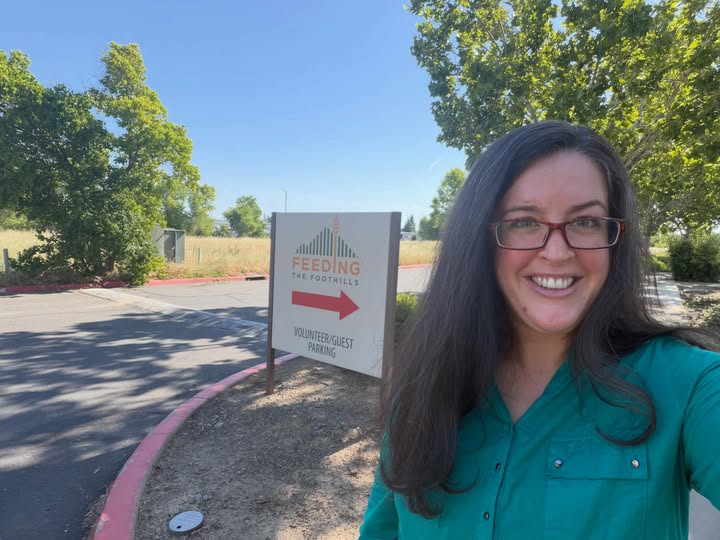
My diagnosis also led me to reconnect with my community. In recent years, my workload didn’t afford me the opportunity to volunteer or serve on boards as I had done in the past. However, I’ve made the community part of my healing journey. Since my breast cancer, I volunteer weekly at the community food distribution in the Lincoln community through an agency partner of Feeding the Foothills. I’ve also found joy volunteering for the Friends of the Lincoln Public Library (FOLL) through programs like Read Across Lincoln, providing a story time and free book to all first-grade students in the Western Placer Unified School District. These two organizations bring me back to the fundamentals I learned from my mom when serving the community. She felt passionate about ensuring basic needs of food were met and would include her low-income kindergarten students in our grocery shopping to ensure the whole class had fresh fruit during snack. Beyond this, she felt that reading was a fundamental right and supported curriculum and standards for the State of California. It’s living as her legacy why these two particular organizations bring me such joy and satisfaction.
How did breast cancer impact you and your family the most?
Breast cancer was my big wake-up call that everything needed to change. Since my diagnosis, I’ve completely turned around my health by prioritizing movement, eating foods with intent, and finally being physically present despite plenty of naps to battle the ongoing cancer fatigue. The impact on all of us was initially fear with many unknowns, which turned into gratitude that things could be much worse. We’re thankful for the cancer team at Mercy San Juan Cancer Center, including my enthusiastically passionate general surgeon, Joelle Jakobsen.
What advice do you have for people afraid to get their screenings?
I’d encourage them to be more afraid of the unknown or neglecting the opportunity to catch cancer early before it spreads. It’s devastating to hear the words “you have cancer.”
However, it’s much worse to hear that you’re terminal because your fear allowed the cancer to grow and spread. Your risk of dying is significantly lower the earlier cancer is detected. Give yourself the opportunity to live a long life. If anything, do it for your friends and family – they also deserve the chance to be with you for many years to come.
Recent Comments